
Custom Website vs WordPress: Which Is Better for Your Business in 2026?
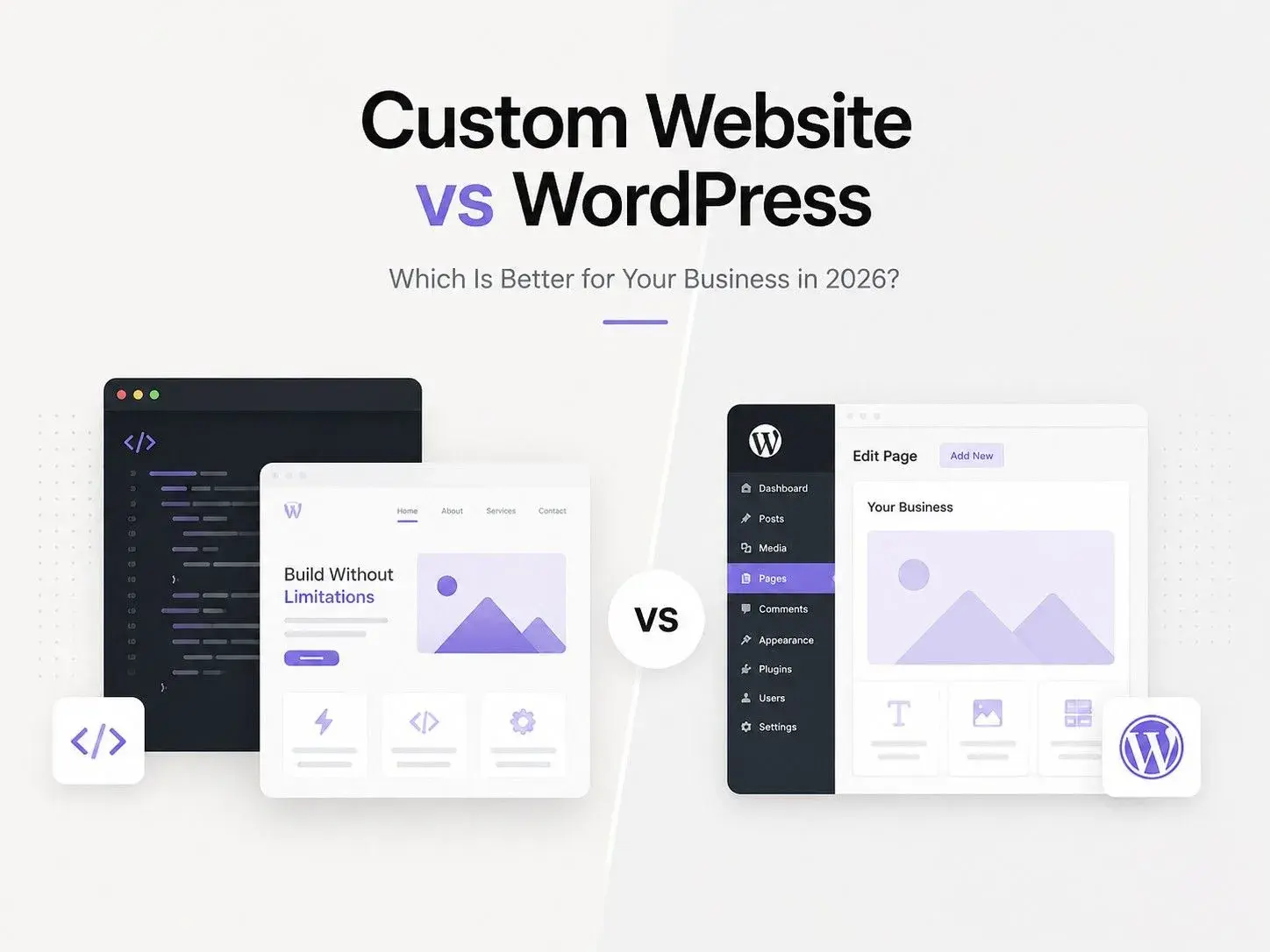
You have decided your business needs a website. Now comes one of the most important decisions: should you build a custom website or use WordPress? There is no universal answer. WordPress can be an excellent choice for some businesses, while custom website development may be the better long-term solution for others. The right choice depends on your budget, required features, performance expectations, scalability, security, and future business goals.
What Is a WordPress Website?
WordPress is a popular Content Management System (CMS) that allows businesses to build and manage websites using themes, plugins, page builders, and custom development. Instead of developing every feature from scratch, developers can use the existing WordPress ecosystem to create websites faster and at a relatively lower initial cost.
WordPress is commonly used for business websites, blogs, portfolios, news websites, landing pages, and e-commerce stores. Its biggest advantage is convenience. Businesses can easily manage pages, publish blog posts, update images, and modify content without needing a developer for every small change.
What Is a Custom Website?
A custom website is designed and developed specifically around the requirements of a business. Instead of relying heavily on pre-built themes and plugins, developers create the website architecture, user interface, backend functionality, database, APIs, and integrations according to the project's needs.
Modern custom websites may use technologies such as React or Next.js for the frontend, FastAPI, Django, or Node.js for the backend, and databases such as PostgreSQL or MySQL. The exact technology stack depends on the project. The main advantage is flexibility—the technology is selected around the business requirements instead of forcing the business into a predefined system.
Custom Website vs WordPress: Cost
Cost is often the first factor businesses consider. WordPress websites generally have a lower initial development cost because developers can use existing themes, plugins, and CMS functionality. For a standard business website with pages such as Home, About, Services, Portfolio, Blog, and Contact, WordPress can be a cost-effective solution.
Custom website development usually requires a larger initial investment because more design and engineering work is involved. Developers may need to build custom user interfaces, APIs, database structures, authentication systems, dashboards, and integrations. However, choosing only based on the lowest initial price can create problems if the business later requires functionality that the original website was not designed to support.
Which Offers Better Design Flexibility?
WordPress provides thousands of themes and page-building tools, making it possible to create professional websites relatively quickly. However, highly customized designs may become more difficult when developers have to work around theme restrictions, page-builder structures, and plugin compatibility.
Custom website development provides significantly more design freedom. Layouts, animations, interactions, navigation systems, and user journeys can be created specifically for the brand. If your business needs a highly distinctive digital experience rather than a conventional website layout, custom development usually provides greater flexibility.
Website Performance and Loading Speed
Website speed directly affects user experience, conversions, and search engine performance. A properly optimized WordPress website can be fast, but performance problems often appear when websites accumulate too many plugins, heavy themes, page-builder scripts, third-party integrations, and unoptimized images.
Custom websites give developers greater control over performance. Modern development frameworks can use techniques such as server-side rendering, static generation, code splitting, lazy loading, image optimization, and CDN caching. This can result in extremely fast websites when the application is engineered correctly. However, custom code is not automatically faster—poor development practices can make any website slow.
Which Is Better for SEO?
A common misconception is that WordPress automatically ranks better on Google or that custom-coded websites have an SEO advantage. Neither statement is universally true. Search engine rankings depend on factors such as content quality, search intent, website architecture, loading speed, mobile usability, internal linking, backlinks, structured data, metadata, and technical SEO implementation.
WordPress makes many SEO tasks easier through plugins that help manage titles, meta descriptions, XML sitemaps, redirects, and other settings. This is particularly useful for businesses that regularly publish blog content. A custom website can provide equally strong or better technical SEO when metadata, structured data, sitemap generation, rendering, URL architecture, and performance are implemented correctly.
The most important point is that technology alone does not create search rankings. Both WordPress and custom websites can perform extremely well in search engines when they are properly developed, optimized, and supported by high-quality content.
Scalability and Future Business Growth
Your website today may be very different from what your business needs three years from now. You may eventually want customer accounts, online payments, appointment booking, CRM integration, dashboards, vendor portals, real-time notifications, advanced search, or custom reporting. The website architecture should be capable of supporting future growth.
WordPress can handle substantial traffic and complex websites when properly configured. However, businesses with increasingly specialized workflows may become dependent on multiple plugins and custom modifications. This can make the system harder to maintain as complexity grows.
Custom development allows the architecture to be designed around expected growth. APIs, databases, authentication, infrastructure, integrations, and business logic can be structured according to the application's requirements. For complex digital platforms and web applications, custom development generally provides greater long-term flexibility.
Security: WordPress vs Custom Website
No website technology is automatically secure. Security depends on development quality, hosting configuration, software updates, authentication practices, access controls, backups, and ongoing maintenance.
WordPress websites often depend on third-party themes and plugins. Every additional component creates another dependency that must be maintained. Outdated or poorly maintained plugins can introduce security vulnerabilities, which is why regular updates, backups, security monitoring, and trusted plugins are essential.
Custom development provides greater control over architecture and dependencies, but custom code introduces its own risks. Poorly implemented authentication, authorization, API security, database queries, or session management can create serious vulnerabilities. A custom website is only as secure as the engineering behind it.
Website Maintenance
Every website requires ongoing maintenance. WordPress websites commonly require core updates, plugin updates, theme updates, backups, security monitoring, and compatibility testing. The advantage is that non-technical users can often manage everyday content changes through the WordPress dashboard.
Custom websites require a different type of maintenance. Developers may need to maintain frameworks, dependencies, APIs, databases, server infrastructure, and security patches. While there may be fewer third-party plugins, maintaining custom software generally requires stronger technical expertise.
Custom Functionality and Integrations
For standard functionality such as contact forms, blogs, galleries, and basic e-commerce, WordPress offers many ready-made solutions. This makes it efficient for conventional business websites where the requirements are already well understood.
The situation changes when a business needs specialized workflows. Imagine a platform where customers create accounts, submit project requirements, receive automated estimates, track project status through dashboards, receive real-time notifications, and synchronize information with a CRM. At this point, you are building something closer to a web application than a traditional website.
WordPress can support complex functionality through plugins and custom development, but forcing highly specialized systems into a plugin-based architecture can create unnecessary technical debt. For unique workflows and advanced integrations, custom development is often the stronger approach.
When Should You Choose WordPress?
WordPress is a strong choice when your primary requirement is a content-driven website. It works particularly well for small business websites, corporate websites, blogs, portfolios, news platforms, service websites, and businesses that frequently need to update their own content.
If your requirements are relatively standard, your budget is limited, and you want to launch quickly, WordPress may be the more practical option. Using a mature CMS instead of developing unnecessary custom functionality can save both development time and money.
When Should You Choose a Custom Website?
Custom website development is usually more appropriate when your project requires specialized functionality, unique user experiences, complex integrations, or significant scalability. Examples include SaaS applications, customer dashboards, marketplace platforms, custom booking systems, membership platforms, B2B portals, workflow automation systems, and real-time applications.
Custom development may also be the better choice when website performance, brand-specific design, advanced integrations, or future expansion are critical business requirements.
Do Not Choose Technology Before Defining Your Requirements
One of the biggest mistakes businesses make is choosing technology before understanding what the website actually needs to accomplish. Some businesses immediately decide they need WordPress, while others insist on technologies such as React without considering whether that complexity provides any real business value.
A better process is to define the business objective, target users, required features, content structure, scalability requirements, budget, and expected future growth first. The technology should then be selected based on those requirements.
Building a simple five-page company website using an unnecessarily complex application architecture can increase development costs without providing meaningful benefits. At the same time, building a complex customer platform entirely around plugins simply because it is cheaper initially can create expensive technical problems later.
Custom Website vs WordPress: Which Should You Choose?
Choose WordPress if you need a relatively standard business or content website, want easy content management, have a limited budget, and need to launch quickly. It provides a mature ecosystem and can be an efficient solution when your requirements fit naturally within a CMS.
Choose custom website development if your project requires specialized functionality, complex integrations, unique user experiences, advanced scalability, or application-like features. The higher initial investment can provide greater architectural flexibility when the business has complex or evolving requirements.
Final Thoughts
The best website technology is not necessarily the newest, most expensive, or most popular. It is the technology that fits your business requirements. A local service business may gain very little from paying for an unnecessarily complex custom application, while a growing digital platform may create expensive technical problems by choosing a basic architecture simply to reduce its initial development cost.
Before choosing between WordPress and custom development, ask two questions: What does the website need to accomplish today, and what might it need to accomplish two or three years from now? Those answers should guide your technology decision.
At Webentric, we design and develop websites around real business requirements rather than forcing every project into the same technical solution. Whether you need a professional business website, an e-commerce platform, a landing page, or a custom web solution, the goal is simple: build the right solution for the problem.
Planning a website for your business?
Get a fast, SEO-friendly website designed for Indian businesses — priced transparently in rupees.
Related articles
 WEB DEVELOPMENT
Why Your Business Needs a Professional Website to Grow in 2026
In 2026, customers don't just visit businesses—they research them first. Whether someone is looking for a restaurant, a…
Read article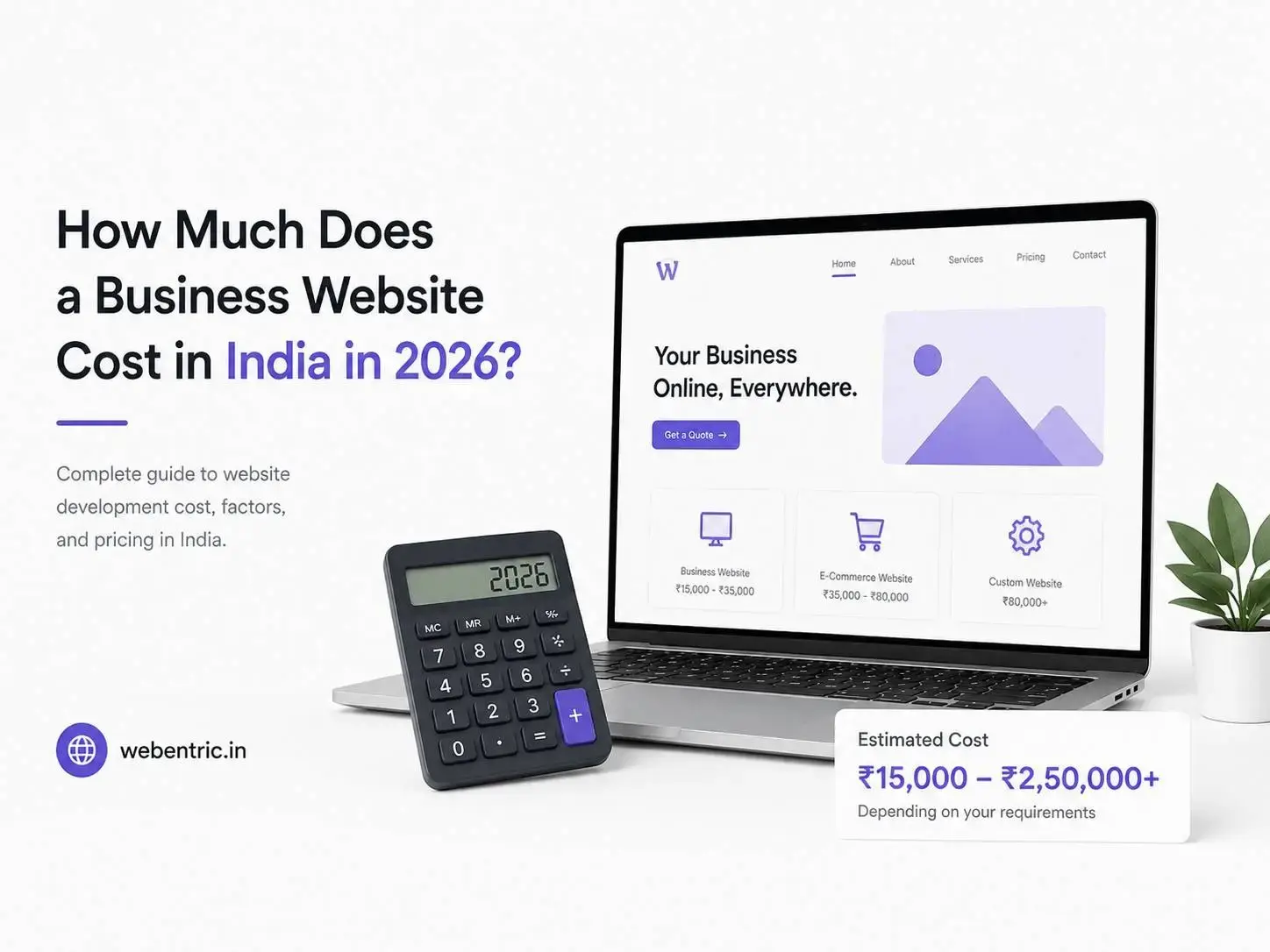 WEB DEVELOPMENT
How Much Does a Business Website Cost in India in 2026?
One of the first questions business owners ask when planning their online presence is simple: 'How much will a website cost?'…
Read article